Tuesday, March 8, 2022

2022 - Lonjezo University, Malawi

Dear friends,

Thank you for taking time to opening up this blog. Welcome to any new viewers and welcome back for those who have been following my blog for a while. Below, I will share a bit about the work we have been doing for Lonjezo University.

This story is about the people who touch our lives and encourage us on our faith journey. Some of these people may not be the most prominent in our lives and if we don't pay attention, we may miss the richness those encounters bring. These are the "hidden figures" in our lives.

As a representative from EMI Canada I was asked to visit a potential project site for UrbanPromise International. EMI is a non-profit Christian development organization whose mission is to mobilize volunteer design professionals to provide affordable design assistance to ministries in under resourced communities who are helping the poor and proclaiming the gospel of Christ. 

Figure 1: photo of site


Above is the proposed site for the future Lonjezo University campus at the edge of lake Malawi.

Figure 2: Location map of Malawi


We were tasked to investigate the feasibility of this site for such a university and to help develop the programming for the university:

Figure 3: proposed bubble diagram of proposed Lonjezo University

Most of my blogs are about architecture and site planning, but this trip quickly impacted me to understand it was more about the people instead of the buildings or site:

Figure 4: working session with Peter and Za


Although God is always the protagonist in His story, here are the people I was impacted by during this trip to Malawi. First, are our local ministry partners, Dr. Zamumtima Chijere (Za), and Peter Gamula.
Za reminded me that the person who is the quietest in the meeting is not always the person with the least amount to say. Za is a humble, humble guy. He doesn’t tell you that he is a Phd graduate at Eastern University. He has come back home to Malawi to help his family, community and children to have a place to go after high school. The United Nations estimates that less than 10% of people who graduate from high school have the opportunity to attend some sort of post-secondary education. This is mainly due to lack of schools and costs associated with schooling


Figure 5: One of the various high schools we visited

Peter Gamula reminded me that Lonjezo university is all about the kids. He cared enough to allow us to hear the stories of the young women at Voice Arise and he mentors them and the students in the high school he started in Malawi in a very fatherly way. 

Figure 6: lunch program at Voices Arise


Figure 7: photo of one of the lab classrooms we researched

“Uncle Peter” is driven by this to the point of driving through flooded areas to get us to the site after the torrential rainstorm. We trekked through flooded streets – flooding not seen in the past 10 years! Check out this video from our drive through the floods:

Video of our drive through the floods

It is by faith we are saved. And it is by faith we are driven to do good work. That definitely resonates with me. But it was my pastor, Joyce Rees at my local church here in Calgary who reminded me how important it was to have a prayer team during the project trip. For sure, those prayers definitely made me aware that it was one of the reasons we made it through the flooding. How often have I been part of the prayer team for others, but this day it was my fellow brothers and sisters back home lifting us out of the flooded waters. At some point in our lives, we are those “hidden figures” encouraging and lifting up others in prayer in His great story.

Figure 8: photo of one of the flooded villages along the way

And then there are my teammates, Farai and Joseph. Talking about one of our core values of diversity at eMI, here is a picture of us: from the right, Farai (from Zimbabwe), Joseph (from Uganda), Peter (local to Malawi) and me (one Asian guy):

Figure 9: team photo

Farai has deep caring eyes. She thinks of others first. During one of our visits to a local high school, the students asked what we did for a living and when Farai told them she was an architect, their eyes lit up and I could tell right there and then, that she inspired a classroom of young women to pursue architecture as a profession! We are hoping that this is the promise that Lonjezo University fulfills (Lonjezo means “promise” in Chichewa)

Figure 10: photo of Farai speaking to the girls at Voices Arise

Joseph is really smart and care about people; he is quiet so people may not view him that way. On zoom calls with our Clients, Joseph has very little to say, but when performing investigation tasks like water tests needed to be done on site, Joseph provided the greatest amount of energy and perseverance.

Figure 11: A photo of one of the many water test pits that we dug on site

And then there is me, flawed and soft spoken in human ways – I was still invited to be the guest speaker in Chapel at the African Bible College in Lilongwe. It was a large space, big enough to seat 300 students and when the power went out, there was very little light, so I could not see my notes. Without a microphone, I stretched my voice to project as much as I could, but I only ended up feeling like I was yelling. The Lord was gracious to me however. At that moment, He reminded me that I was still His beloved and that I did not need to be the vociferous preacher of old, but I just needed to deliver the words that He gave me to speak. The passage I was given to share on was Colossians 3:2 (NIV) “Set your minds on things above, not on earthly things.” Little did I know that it meant for me to focus on God given words instead of earthly things like a microphone and auditorium lighting. Again, I felt the prayer team come through for me; lifting me up in a time and place of unfamiliar grounding.

In the end, it was such a blessing to reach the students who sat in the first 10 rows or so. Using a strange Canadian word, those are the “keeners” who got the message. They loved learning a few Chinese words too and hopefully feel as blessed as I was to participate in the small ways that our Lord and Saviour allows to participate in.

After the project trip, I worked in our Cape Town office for a couple of days as Farai and Joseph are based out of that EMI office. During a time of office devotions, each of us were challenged to write a Psalm to God. Inspired by our project trip, here it the one that I wrote,

“Sing a song, sing a new song unto the Lord. Sing a new song. Sing a new song. Sing it aloud. Proclaim His goodness and faithfulness that carries us through even the floods. Proclaim His name, all the earth, so that the children may know the fulfilling of His promises from generation to generation. Let the children sing. Sing a song, sing a new song unto the Lord.”

Thank you for reading to the end!

Grace and Peace,

Dan


Sunday, December 19, 2021

2021 - LINK Village

Dear friends,

Thank you for taking time to opening up this blog. Welcome to any new viewers and welcome back for those who have been following my blog for a while. Below, I will share a bit about the work we have been doing for LINK Village in Kamloops, BC.

This story is about God's redemptive work being done today. There are glimpses of His Kingdom breaking in our own backyards. We don't always have to wait to get to heaven to see all this.

I recently interviewed Isabelle Meunier of the LINK Village Society to hear about her vision for serving broken families, how we helped her take the next step, and the things that God is doing in Kamloops, BC.

In British Columbia, there are over 8,900 children who do not live with their biological parents, 65% of whom are Indigenous. With the recent finding of the remains of 215 residential school children near Kamloops, the call for reconciliation with Indigenous communities is stronger than ever. In a recent interview, our ministry Client Isabelle laments,

“It breaks my heart. They blame the Church for that. And that's not Jesus. Jesus came to this planet to break those things and proclaim the good news of God's kingdom. And in God's kingdom, there is no racism. There's no division.”

Equipped with the vision, but not sure where to start, LINK Village Society connected with us in mid-2021. Isabelle said, “I have absolutely no knowledge of construction or any steps needed to be done to achieve such a vision.” I told her, "We can help you get started."

One of the diversity goals for EMI Canada is to look to collaborate with our Indigenous people group (First Nations). What better way to start by having our first domestic project as serving indigenous children?

I gathered a small team of design professionals to help Isabelle and LINK refine their vision, navigate conceptual visioning and design challenges:

In an attempt to live into a restorative world, this project is proposed to be a community center, day care, 9 homes on government land and is in some small way a start to this kind of restoration as a signpost to the redemptive world we aspire to live in. 

Isabelle gave us a heartfelt thank you during the closing meeting, “EMI has been so amazing. From the beginning, EMI was able to come alongside and to listen and capture the vision. And that is a gift itself; to be able to listen in a way where they can put it onto paper. More than just their skills in architecture and project planning, the EMI team was able to provide LINK with something deeper.”

LINK as an acronym for Love In Nations Kind – to be a sustainable source of affordable housing and resources that keep children with their families.

In the indigenous tradition, restoration of people and land go hand in hand. 

In recent news, the land Kamloops wants to donate to LINK village is part of that remediated site where the 215 unmarked graves were originally found. Is this restoration in both the "redemptive" kingdom building as well as "truth and reconciliation?" You be the judge.

Grace and Peace,

Dan 

Tuesday, December 1, 2020

2020 - SIM Galmi Hospital

Dear friends, thank you for taking time to opening up this blog. Welcome to any new viewers and welcome back for those who have been following my blog for a while. Below, I will share a bit about the work I have been doing for Galmi Hospital this past year.

Located on the edge of the Sahara Desert, SIM’s Galmi Hospital (Galmi) has been providing compassionate medical care in Jesus' name since the 1950’s. We are currently working on phase 4 of the development plan. As Galmi's medical, training, and discipleship ministries have grown, it is now a referral center for central Niger and surrounding countries. Here is a photo from the 1960's:

And one from 2020:

From August 2020, I worked remotely from EMI Canada with local SIM Galmi leaders and an EMI engineer on site during the Fall of 2020 (his is a long term partnership as EMI's phase 1 of this project started in 2008). Together, we conducted interviews from the local and missionary doctors and nurses to gather information for a future EMI team and update the masterplan. The reason to interview the staff is to better understand the needs and desires of each department, so that we can better plan their spaces in the future. Below is an image of the existing HIV consulting room in the outpatient department which is also used to keep some files:

EMI is a non-profit Christian development organization whose mission is to mobilize volunteer design professionals to provide reduced cost design assistance to ministries in under resourced nations who are helping the poor and proclaiming the gospel of Christ. 


As you can see from the these two pictures above, not a lot has changed from the 1950's to the 2020's. But the condition of the structure has deteriorated as you can image after 70 years of operation. Below is a photo of the top of the exterior wall. This building will need to be demolished, redesigned and rebuilt in the coming years:

The adjacency diagrams below is a tool used by a lot of Architects like myself. It will initially focus more on functions rather than buildings, but one story it does tell is how prominent evangelists need to minister to the patients:

In re-planning the hospital, it gives us a chance to separate the ER from the Medical Ward building like some other African hospitals have done. The existing ER is currently located inside the existing Medical Ward:


In natural progression, these are placed on a site plan to more clearly understand how each function relates on the site:
As part of an expanded phase 4, EMI has been asked to look at the expansion of the existing CREN. The CREN (Centre de Rehabilitation et Education Nutritionnel) is the nutritional rehab center for malnourished children under the age of five. It was established as a place where local mothers could find practical ways in helping care and learn how to provide nutritious food on a low budget using local ingredients.

Lastly, by reducing the size of buildings at the entry, it also allows the hospital to have a better triage space at the entry. Even though this has always been important during TB and Malaria season, it is becoming even more pronounced in the COVID pandemic times:


The United Nations reports that Niger is one of the least developed nations on our planet with a high majority of citizens who live below the poverty line. It is one of the reasons that it has takes some time go get from Phase 1 to Phase 4. In the coming years, other projects like new Surgical Wards will also need to be planned for. Below is an image of the existing surgical ward:


“Unless the Lord builds the house, its builders labor in vain”. (Psalm 127:1)

Thank you for reading to the end!
Grace and Peace,

Dan


Sunday, December 1, 2019

2019 - 2024 Quad-E, Malacca, Malaysia


We were privileged to serve the local Quad E ministry in Malacca, Malaysia. The ministry was started by Dr. Boon Hock Lim pictured on the left here with his wife Queck  -  simply for the sake of finding a home for Matthew, their son who is now 33 years old in 2024 has Russell Silver Syndrome (a growth disorder akin to Down syndrome and Autism).
Photo credit: Anna Seeley
This campus is for special needs residents like Matthew. It is a safe place where residents can live, work, study, and play. Why should they not have that opportunity? Accessibility is defined as the manipulation of the physical environment so that everyone regardless of special needs or not can enjoy the same spaces to live, work and play. This project is operated out of our EMI Cambodia office (Petram): where I served as the Sr. Architect. Malaysia is situated in southeast Asia. It is composed of two regions: Peninsular Malaysia in the west and lying between Thailand and Singapore.


In 2019, one of the first things we do is walk the site with the local host ministry to gain a more tactile sense of site’s design constraints. Another thing I wanted to impress upon you is the steepness of the site. There is a 10 m difference between the river and the road (which is like a 3 story building).
Survey and Civil 3D by Vannlydeth Chen

While the survey team does the survey work in the hot and humid climate, the designers are back in the air conditioned office running the programming meetings with the Client and studying the site in sketch format. 
Photo credit: Anna Seeley
You see below the three primary options to build on the flattest area of the land while avoiding the steep areas as much as possible.
Masterplanning sketches by Dan Chong, EMI Architect
Designing for special needs residents is partially like designing an accessible site for the handi-capped. While we were studying site, we noticed how the 4 E’s of Quad E’s four main objective aligns well with 4 accessibility concepts used in the ADA (Americans with Disabilities Act). This chart represents the heart of the project 


Accessible route means that each of the buildings can be accessed not only for cars and fire trucks, but for future considerations when they are able to accept residents who may be confined to a wheelchair.

One of our primary recommendations was to place all the primary functions of each building on the ground floor to be accessed directly from grade. This is the most cost effective approach for a rural site such as this. 


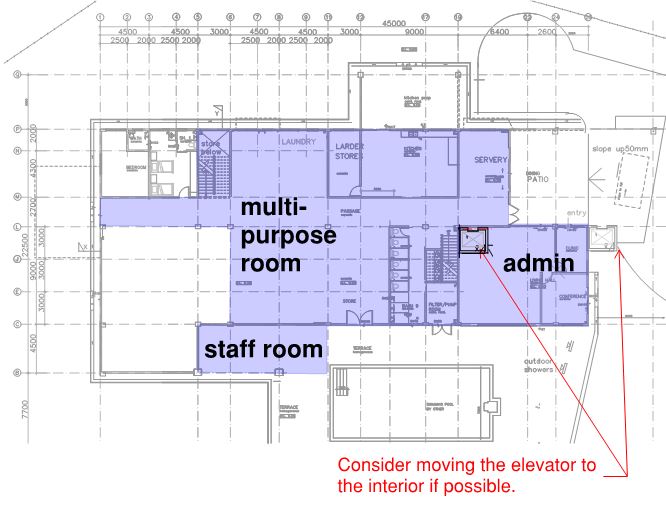
The Admin block houses a multi-purpose room for 100 persons to meet; which can be subdivided into two smaller classrooms of 50 people. As a Christ centered ministry, it was important for Quad E to have a chapel space for 40 people. We have located this in the most prominent center part of the site. There is also open offices and conference room in case an administrator would like to meet with potential residents. The bathroom spaces you will notice are larger than usually seen in Malaysia because they are using clearances for potential future wheelchairs.


Rendering by  Vuth Nuon, EMI (Petram)

Above is the exterior rendering of the Admin building. One thing we noticed at Boon Hock’s office was a small bell they use to let Matthew know it is time to change activities or simply a ring for lunch or dinner time. It is the auditory signal that provides order and comfort or a predicable day for adults of special needs.

So, at the top of the Chapel – we have a bell tower to mark the chapel and the entry to the site. It sits one of the highest part of the site at the main entry.

Sometimes, we are called to take care of more than just one person in our lives. Even if this person is your own child. Boon Hock has been called not only take care of just Matthew…but a larger population group of adults with special needs. This bell tower you see is a metaphor to explain the care that Mathew gets as an individual (from Boon Hock and Quek) is scalable to a larger group of people. It represents the aspirations of Quad E and what they are planning to use this site for. I share a personal connection with Boon Hok when we are able to share our own research with each other about how to care for the special needs population.

The other two images below are of bell and clock towers in the historic part of Malacca just to show you that this kind of element is not foreign to Malacca, and was actually used in a more pioneering time.

The layout of this building is primarily inspired from a school for autistic children. In contrast to more traditional classrooms, we discovered that teachers wanted their own desk space which allows some privacy, but not completely away from the general classroom setting. There is a quiet room which affords teachers to take students who are having difficulties out of the classroom setting, and bring them back once they are calmer. 


Here is the exterior of our Therapy building which we have designed screens on the exterior with plants. Hopefully this will shield the windows from moving cars and pedestrians, but still provide sunlight though the windows (and therefore less reliance on electrical lighting during daytime hours).

Rendering by Menea Ly, EMI (Petram)

The Therapy pool is comprised of two separate pools; one indoors with therapy jets which can be used year round. But because Malaysia is quite warm for most of the year, the primary swimming pool is located outdoors under a fabric tent which provides a softer feel to the swimming environment.
Rendering by  Sereyuth Nuon, EMI (Petram)


Calming activities: For adults with special needs, there is always a need for calming activities which provides a break the noise around them. For instance:
1)      An accessible playground, but will have age appropriate play equipment

2)      An opportunity to access the creek at the bottom of the site for aquaponics activities like fish farming, and aquaponics farming. This provides a sense of normalcy in the lives of adults with special needs. It allows them to feel like any one of us who get in a car in the morning to go to work and come back in the afternoon.

3)      There is also a restrictive 3 m planting set back all around the property line as well as a 6 m building line set back, so a total of 9 m. We are taking trying to take advantage of that by providing planting area which the residents can use like another calming activity.


Residential Buildings: now heading to the other side of the site, this is the residential building that the residents live in. Each building has space for two live in care givers. The bathrooms and kitchens may look bigger because they require wheelchair access – just in case there is a need for that in the future. From interviews with parents with adults with special needs, there was a desire to have a secondary meeting room that can be used privately between the parent and resident in privacy without disturbing the other residents.

Guesthouses: The last accessibility concept to look at is visit-ability. The primary functions of the guesthouses are all available on one floor which is accessed from grade. Guesthouses are for parents to stay overnight in, but also has a lower level which can house family members traveling with the parents. The lower level is not on the accessible route, but not all the spaces need to be accessible if each one of the primary function spaces are accessible from the ground floor.

As you can see from the rendering, space for the lowel level is available due to the extreme sloping of the site. It is a space that exists anyways due to the steepness of the site.
Here is a quick video fly through of the site planning:

Video fly through by Menea Ly, (EMI Petram)
Finally, here is our EMI project team: 

Top Row: Kathleen Wassenaar (EMI Project leader), Menea Ly (EMI-Petram Arch), Dan Chong (EMI Canada), Vicky Mah (EMI Project leader), Marin Chuuong (EMI-Petram Civil), Anna Seeley (EMI videographer)
Bottom Row: Lydeth Chen (EMI-Petram Civil), Vuth Nuon  (EMI-Petram Arch), Evan Dahl (Civil Engineer volunteer)


In keeping with our EMI Core Values of Design, Diversity, and Discipleship - on our design team, we had three Americans, two Canadians, and four young Cambodians; they were a real encouragement to me as they provided the "energy" for the design team!

In 2022, we discovered through the ministry client that there exists a zoning restriction for this site to be developed primarily as an agricultural site, but the main building on the site can be as large as needed - but it does need to be one building. Since concept design was finished, we were able to pass on the conceptual design ideas to a local architect who took the development of the design through the zoning process and through detailed design in 2023. We even introduced the client ministry to a local ministry and vendor who supplies systems for organic farming for a facility for the disabled in Singapore:


In a visit in 2024, we discovered that zoning was recently approved. Below are simple phasing mark-up plans of the ground floor and 1st floor plans we shared with the client ministry:
phase 1 (0-5 years) and phase 2 (5-10 year) plan


first floor phase 1 in blue


ground floor phase 1 in blue
Phase 1 circulation and stacking diagram


site visit with Boon Hock


and finally, the construction permit for construction fencing!